
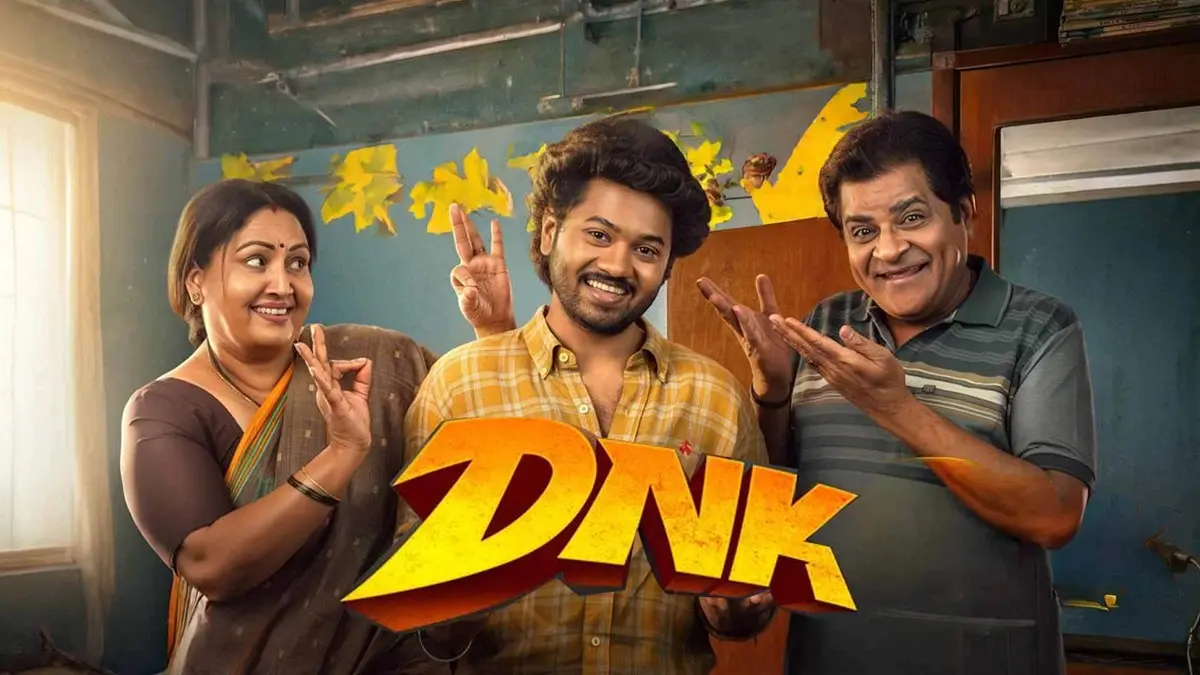
Mouli became a familiar face among Telugu audiences with the web series ’90s – A Middle Class Biopic, and then made an impressive big-screen debut with the success of Little Hearts. His natural comic timing and boy-next-door charm have earned him a decent following, particularly among younger viewers. So, expectations were naturally high for his next film. Titled Donga Na Koduku initially and later shortened to DNK, the film promises a crime comedy. But does it give Mouli another hit, or does it struggle to deliver the laughs? Here’s what works and what doesn’t.
DNK (Donga Na Koduku) Story
Eeshwar (Mouli) is a B.Tech dropout from Visakhapatnam who spends most of his time roaming around without much concern for his future. He wants to make lakhs without putting in the effort, and online betting soon becomes an addiction. His attempts to arrange money get increasingly ridiculous. He steals small amounts from his own home, borrows through loan apps and even pawns his girlfriend Deepu’s (Sushmitha Shetty) gold rings to spend more money on betting.
Things get worse when Deepu’s parents discover what has happened and turn up at Eeshwar’s house, leaving his family embarrassed in front of everyone. With debts piling up and no easy way out, Eeshwar joins hands with his friend Bablu and comes up with a plan to rob a jewellery shop. But the robbery doesn’t go the way he expects. How does this plan change Eeshwar’s life? What is the mystery surrounding the jewellery shop heist? And can he somehow get himself out of the trouble he’s created? That’s the story of DNK.
Analysis
When you go to watch a Mouli film, especially after seeing his comic timing in Little Hearts, you naturally expect a couple of hours of easy laughs. Director Srinu Kambala seems to understand that at first. The basic premise is interesting, and the way Eeshwar’s character is introduced gives the film a reasonably entertaining start. His money troubles, the scenes where his parents get caught up in loan-app harassment, and the romantic track with Deepu provide a few good laughs in the first half.
The trouble starts when the story moves towards the jewellery shop robbery. From that point, the screenplay loses its grip. Instead of building a proper crime-comedy narrative, the film keeps throwing in one situation and twist after another, hoping that something will work. Twists can be fun when they catch the audience off guard, but DNK has so many of them that the story eventually becomes confusing. After a while, you stop being surprised and start wondering when the film will get to the point.
Even smaller scenes are stretched longer than necessary. The portions involving a missing bag and the attempt to sell gold, for example, could have been handled much more quickly. They add very little to the story and make the film feel unnecessarily long. The humour doesn’t help much, either. Some dialogues rely on old social media memes, while several double-meaning jokes feel forced. That kind of comedy doesn’t really suit Mouli’s usual screen image.
The second half is where these problems become even more noticeable. The film keeps jumping between situations without giving the central story enough direction. What begins as a crime comedy gradually turns into a noisy collection of jokes and twists, and the laughs become increasingly hard to come by.
Cast Performances
Mouli clearly puts in the effort and tries his best to hold the film together. His body language and dialogue delivery suit the carefree youngster, and he has good energy in scenes with Bablu and Deepu. However, the innocent charm that worked so well for him in Little Hearts isn’t quite there this time. The character is written differently, of course, but the comedy doesn’t always feel as natural as it should.
Sushmitha Shetty looks good on screen and does a decent job as Deepu. Her role, however, doesn’t offer much beyond that of the innocent girlfriend. The actor playing Bablu deserves a special mention. His timing brings some life to otherwise dull stretches, and he manages to rescue quite a few scenes. He is one of the film’s more enjoyable additions.
Ali and Rajitha are adequate as Eeshwar’s parents. Ali gets a few laughs through his spoof of Balakrishna’s dialogues, while Gundu Sudarshan, Raghu Babu and Bhadram do what is expected of them. Satya makes a brief appearance towards the climax, but it doesn’t leave much of an impact. Jayakrishna’s character, meanwhile, gets a lot of buildup, only for its eventual conclusion to feel like a letdown. There’s very little payoff for all that attention.
Technical Aspects
Surya Balaji’s cinematography is one of the film’s positives. Even though much of the story takes place in a limited number of locations, the visuals look colourful and neat. Sinjith Yerramilli, who delivered a chartbuster album for Little Hearts, doesn’t have much room to show what he can do with the songs here. His background score does try to lift a few of the slower scenes, but there’s only so much it can do.
The editing by Sridhar Sompalli could have been considerably tighter. Several portions, particularly in the first half, go on for too long, and a sharper cut would have made the film feel much more engaging. Despite coming from a major banner like Mythri Movie Makers, DNK appears to have been made on a modest budget that suits the scale of its story.
Director Srinu Kambala starts with an interesting idea, but the execution lets him down. The film needed a stronger screenplay, better control over its twists and, most importantly, a more effective balance between the crime and comedy. Instead, the two elements rarely come together as well as they should.
Ultimately, DNK (Donga Na Koduku) has a promising setup and a few entertaining moments, but it struggles to turn them into a consistently funny film. Mouli tries hard, and there are occasional laughs, but the weak screenplay and dragged-out comedy keep this crime entertainer from becoming another Little Hearts.