
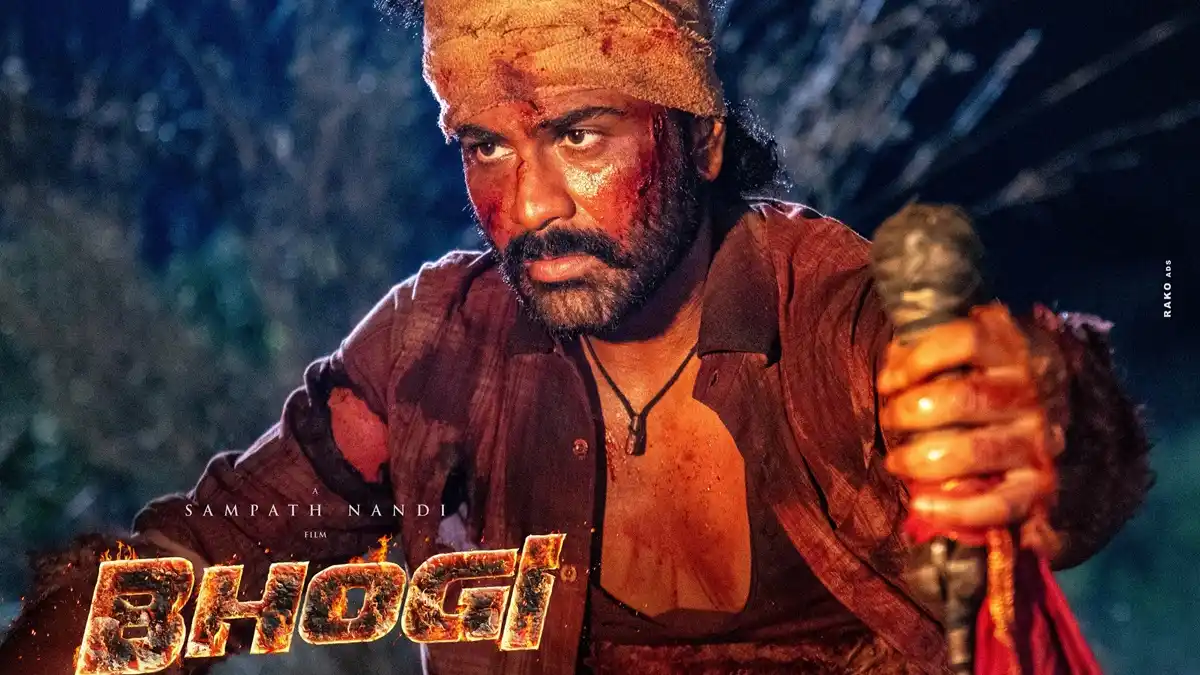
The teaser and trailer of Bhogi created quite a bit of buzz with their raw, rustic visuals, Sharwanand’s mass look and some hard-hitting action sequences. The actor, who has mostly been seen in classy entertainers and family dramas, stepping into a completely different avatar was one of the film’s biggest attractions. Director Sampath Nandi setting the story in a rural world reminiscent of Rangasthalam only added to the curiosity. The film has finally arrived in theaters today, November 27. So, does it live up to all that pre-release hype? Let’s find out.
What Is the Story?
Set in rural Telangana in the 1960s, Bhogi takes place in Boggulagutta, a fictional village on the northern Telangana–Maharashtra border. The village is under the control of its Patel, whose word is final. Nobody dares to question his decisions, and the locals have learned to live with his authority out of fear.
Ganga (Sharwanand), a blacksmith, is an ordinary hardworking man whose entire world revolves around his family. He looks after his household and his five sisters, keeping to himself and going about his daily life. But a series of unexpected events soon turn everything upside down, affecting not just Ganga and his family but the entire village.
The Patel (Sharath Lohitashwa) continues to rule through fear, while the atrocities committed in the village and the secrets hidden behind certain customs gradually push Ganga into a corner. What makes him finally stand up against the Patel? How does he fight back against the injustice done to his family? And what is the dark secret that has been haunting Boggulagutta? The rest of the film revolves around these questions.
Narrative & Analysis
A village ruled by a ruthless Patel, helpless people living under his control and an ordinary young man who finally decides to fight back. There’s a solid rural action drama somewhere in this premise, especially if the story is backed by strong emotions. The 1960s Telangana setting, village traditions, social conditions, family relationships and the struggle against oppression all offer plenty of material for an engaging film.
Unfortunately, Sampath Nandi doesn’t make the most of it. There are some interesting ideas in the story, but the way they’re brought together on screen leaves a lot to be desired. The audience should feel for Ganga, hate the Patel and get carried away when the hero finally decides to fight back. Instead, the film struggles to build those emotions. The conflict is there, but it never becomes as gripping as it should.
One of the biggest problems is the lack of clarity around the characters’ motivations and the central conflict. Certain scenes don’t quite explain why they’re happening or how they’re moving the story forward. As a result, it’s difficult to get completely involved in what is unfolding.
The opening introduces Boggulagutta, its people, the Patel’s hold over the village and Ganga’s family. It tries to establish the period setting while showing Ganga’s affection for his sisters and the responsibility he carries. These are important details, but the initial portions needed more impact. We should have been shown more clearly why the villagers are so terrified of the Patel, how he has managed to maintain his grip for so long and why nobody dares to challenge him. The difficulties faced by Ganga’s family also needed a stronger emotional foundation.
Sharwanand manages to create some interest through his screen presence and action in a few scenes. However, the character itself isn’t written with enough emotional depth. Even when the main conflict begins, the expected intensity doesn’t really come through.
The first half has its share of slow stretches. Several episodes that are supposed to move the story along end up dragging instead. The twists don’t create much excitement either, and by the time the film reaches the interval, the suspense isn’t nearly as strong as it should be.
The second half is where the film really needed to pick up. With Ganga’s life taking unexpected turns, his confrontation with the Patel, the secrets surrounding the village and the revenge angle, there was plenty of scope to raise the stakes. Instead, the screenplay begins to lose its grip after the interval.
Some of the twists leave viewers confused rather than intrigued. The portions involving Mahadeva Pratha and the episodes set around Boggulagutta test one’s patience. Whatever the intention behind these sequences, they don’t translate particularly well on screen.
For a film like this, the audience needs to be emotionally invested in the hero’s rebellion. We should be firmly on Ganga’s side when he decides to fight the Patel. But because the film doesn’t build that connection properly, even the action scenes lose some of their impact. There’s plenty of violence and bloodshed, but brutality on its own isn’t enough. Without the emotional weight to support it, the excessive violence starts feeling like a drawback rather than a strength.
The scenes keep coming, but they rarely pull the audience deeper into the story. Some portions feel too lag, and even the climax twist doesn’t offer much of a surprise. The way the film eventually wraps things up is also disappointing.
Sampath Nandi has chosen an interesting backdrop. A 1960s village, a powerful Patel, people suffering under his rule, injustice against a family and a young man’s fight for revenge — all of this could have made for a compelling drama. The problem is that the director struggles to turn this promising setup into a story that can hold the audience’s attention for more than two and a half hours.
The character conflicts needed more depth, the emotional moments needed better build-up, and the individual scenes should have connected more naturally. We needed to understand why the characters behave the way they do, what finally pushes Ganga into rebellion and what really drives the Patel. These things are never explored as effectively as they should be.
There is no shortage of action, violence or gore in Bhogi, but the emotional side of the story is surprisingly weak. A ruthless Patel controlling an entire village and a family being pushed into suffering should be enough to make viewers angry and invested in the hero’s fight. Yet that connection remains missing for most of the film. The weak emotional payoff, an uneven second half and an underwhelming climax end up being its biggest problems.
Cast Performances
Sharwanand’s mass makeover is easily one of the film’s biggest talking points. The actor, who is usually associated with classy and family-oriented films, takes on a completely different look as Ganga, the blacksmith. The long hair, beard, Telangana dialect and change in body language show how much effort he has put into getting the character right.
He brings good energy to the action sequences and gives the mass moments the intensity they need. There are a few emotional scenes where he tries to make an impression as well. But an actor can only do so much when the writing doesn’t give him enough strong moments. Sharwanand puts in the effort, but the character never gets the kind of memorable scenes that would have made this performance truly stand out. Even good acting has its limits when the overall narrative isn’t working.
Sharath Lohitashwa plays the village Patel, the man whose authority and cruelty drive much of the conflict. The character should have been far more intimidating, with a deeper look at his mindset and the way he exercises power over the villagers. Sharath does what he can with the role, but the writing doesn’t allow the antagonist to make the impact required.
Anupama Parameswaran appears as Sulochana Rani. Her character initially seems to have an important place in the story, but that importance gradually fades. She needed more substantial scenes and emotional moments to leave a stronger impression.
Dimple Hayathi plays Mandaram. Her introduction creates some curiosity, but the character isn’t used particularly well as the story progresses. The limited scope and the way the twists are handled leave her with little opportunity to make a lasting impact.
Lal, Aadukalam Naren, Avinash, Dayanand Reddy and the other supporting actors perform their roles as required. However, the thin characterisation doesn’t give most of them much room to stand out.
Technical Crew
Bheems Ceciroleo’s music, particularly the background score, is one of the film’s weaker aspects. The score is often unnecessarily loud, sometimes overpowering the scenes instead of adding to their impact.
Even the action sequences could have benefited from a little restraint. Not every moment needs deafening music, and sometimes silence can do a much better job, especially in emotional scenes. Here, the excessive volume becomes distracting and makes certain portions difficult to sit through.
Kishore Kumar’s cinematography is one of the few bright spots. He captures the atmosphere of Boggulagutta, the rural landscape and the period setting quite well, with some impressive frames. However, good visuals can only do so much when the screenplay itself has problems.
Producer KK Radhamohan has mounted the film on a fairly grand scale. The sets, costumes and production details help establish the 1960s setting, and there’s clearly been an effort to get the look of the village right. Unfortunately, the story and screenplay don’t have the same strength.
The editing is reasonably effective in the first half, but the second half could have been trimmed considerably to improve the pace. Sharwanand puts in a lot of effort in the fights, though some of the sequences go on for too long. The repeated violence also fails to add the emotional depth the story badly needs.
Final Verdict
Sharwanand deserves credit for stepping out of his comfort zone and putting in the effort to play Ganga. His rustic makeover, action sequences and energy are among the few things that work in Bhogi. Sampath Nandi also had an interesting setting and a premise with plenty of potential. But the weak screenplay, unengaging lags, dragging second half, overpowering background score and disappointing climax pull the film down.
A promising idea isn’t enough to make a good film. It needs a tight screenplay, convincing character motivations and emotions that audiences can connect with. Unfortunately, Bhogi falls short on most of these fronts. Sharwanand works hard, but the film doesn’t give him the right material to make that effort count. In the end, Bhogi turns out to be a disappointing rustic action drama.