
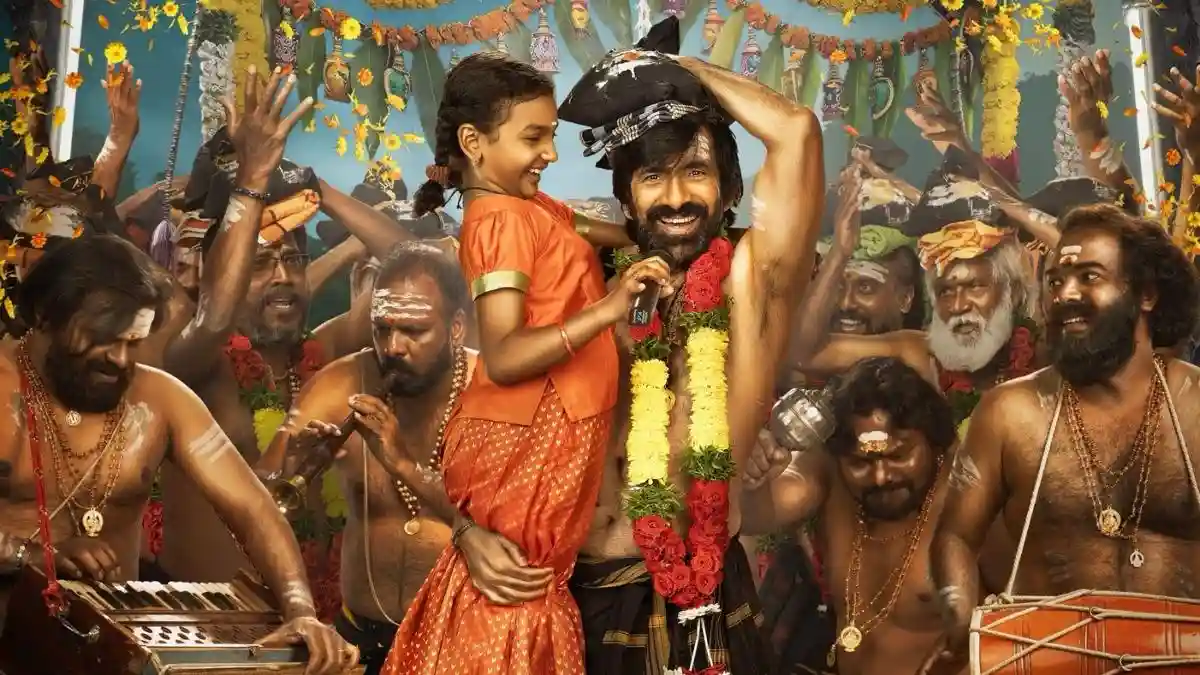
Ravi Teja has spent most of his career playing heroes who make their presence known. They walk into a room, crack a joke, throw a punch, and before long everyone knows who the star of the movie is. Irumudi, directed by Shiva Nirvana, takes a noticeably different route. Ravi Teja plays a much quieter character here, and the film spends more time with him as a father than as a conventional mass hero. Set in rural Andhra Pradesh, the story revolves around family, faith, children and the fear that comes when the people and institutions supposed to protect them don’t do their job. The movie has its share of problems, especially with its pacing and some of the writing, but there is a sincerity to it that keeps the whole thing from feeling like just another commercial drama.
A Rural Story Built Around Family and Faith
Ravi Teja plays Trinath, a farmer and small-time trader living in a remote Andhra village. His world is fairly simple on the surface. He is particularly close to his daughter, cares about the other young girls in the village and follows Ayyappa Swamy with real devotion, taking part in the demanding 41-day Ayyappa Deeksha. But the film doesn’t turn him into some perfectly disciplined, saintly father either. Trinath drinks after the Deeksha, his drinking has caused plenty of arguments with his wife Kaveri (Priya Bhavani Shankar), and there are clearly things about him that aren’t as neat as his village life might suggest.
The movie takes its time establishing all of this, perhaps a little too much time at certain points. Before the main conflict really takes over, we get a fairly long look at Trinath, his family and the village around him. Then the local high school starts becoming a source of concern, particularly because the children aren’t being properly protected from disturbing behavior happening around them. The story could have easily turned into a straightforward revenge movie at this point, but Shiva Nirvana holds back. Even when Trinath’s own daughter is pulled into the situation, the character remains a worried father first. He doesn’t suddenly become an invincible action hero just because the screenplay needs a big fight.
Ravi Teja Leaves the Usual Star Image Behind
The biggest surprise in Irumudi is probably Ravi Teja himself. He doesn’t seem particularly interested in repeating the version of himself we’ve seen so many times before. There aren’t constant punch dialogues, exaggerated hero moments or scenes where everyone else conveniently stops talking so Ravi Teja can take over the frame. Trinath is much more ordinary, and that actually works in the film’s favor.
There are scenes where he looks genuinely unsure of what to do. Sometimes he just sits there and takes in what someone has told him. Sometimes a look says more than the dialogue does. Ravi Teja handles those little moments better than expected, and it gives the character a vulnerability that his more conventional roles rarely allow. He doesn’t have all the answers, and the movie is better when it lets him sit with that discomfort instead of rushing him toward the next dramatic moment.
Nakshatra, as his daughter, also helps considerably. Her scenes with Ravi Teja don’t feel like they’re constantly reaching for an emotional payoff. There’s an easy father-daughter chemistry between them, which makes the later tension matter more. Priya Bhavani Shankar gets less to work with as Kaveri, but she gives the character enough personality to keep her from becoming the usual wife character whose main job is to fight with the hero. Sai Kumar, meanwhile, brings the kind of veteran presence that can make even a relatively small scene feel heavier.
The Film Has Something to Say About Protecting Children
One of the better ideas in Irumudi is the way it looks at two different ideas of protecting girls. One approach is based on fear: don’t go there, don’t talk to strangers, don’t do this, don’t do that. Basically, stay out of trouble and hope trouble stays away from you. Trinath’s approach is different. He wants his daughter to trust him enough to tell him when something is wrong, without immediately worrying that she will be blamed for it.
It’s a simple distinction, but the film gets some mileage out of it. Parents can’t realistically watch their children every second, and constantly telling kids to be afraid isn’t necessarily the same thing as keeping them safe. Shiva Nirvana is also careful not to turn the darker material into graphic spectacle. The movie is more interested in what happens afterward—the fear, shame, anger and confusion that can settle inside a family after something goes wrong.
That restraint helps. The subject matter could have easily been handled in a much more sensational way, particularly in a film built around a star like Ravi Teja. Instead, Irumudi usually keeps the focus on the people dealing with the consequences. The villains are part of the story, but they’re not always the most interesting part of it.
The Village Setting Actually Matters
G.V. Prakash Kumar’s background score does a lot of quiet work throughout the film. The devotional portions connected to Trinath’s Ayyappa Deeksha have a very different mood from the darker stretches of the story, and the music gradually shifts as the peaceful village setting starts feeling less safe.
Vishnu Sharma’s cinematography helps with that too. The village isn’t simply there to give the movie some nice rural images. Its isolation becomes important once the trouble begins. Distances are longer, help isn’t always immediately available, and the characters don’t have the same access to systems that someone living in a major city might take for granted. That makes the setting feel like part of the story rather than just a backdrop.
The downside is that Irumudi can be very slow about getting where it wants to go. The first half takes its time establishing the characters, and there are stretches where the film seems to be saying the same thing again when you’re already quite familiar with the setup. Some viewers may appreciate the patience; others will probably be checking the runtime and wondering when the main story is going to properly begin.
Where Irumudi Doesn’t Quite Work
The film’s themes are stronger than some of its actual writing. A few of the antagonists are fairly predictable, and you can understand what they’re supposed to represent almost immediately. They don’t always get enough personality beyond their role in the plot. The handling of the authorities is another weak point. Whenever the story needs Trinath and the local characters to take charge, law enforcement can conveniently become less useful than you would expect.
That’s especially noticeable because the rest of the movie is trying to take its subject seriously. If you’re asking the audience to think about the real-world consequences of failing to protect children, it becomes distracting when the screenplay suddenly ignores an obvious practical solution just so the hero can remain at the center of the action.
Still, these issues don’t completely take away from what the film is trying to do. There is a genuine interest in parenting, trust and the responsibility adults have toward children. Those ideas aren’t revolutionary, but Irumudi treats them with more care than many mainstream commercial films usually bother to.
Final Verdict
What makes Irumudi interesting is what it refuses to become. With Ravi Teja playing a father caught up in a story involving vulnerable children and injustice, the obvious commercial route would have been to turn Trinath into a revenge machine. Give him a few mass dialogues, throw in some fights, let him beat the villains and roll the credits. Thankfully, Shiva Nirvana doesn’t completely go down that road.
Instead, the film keeps returning to family and the quieter side of Trinath’s character. A worried look at his daughter, a pause before he answers a difficult question, or the moment when he realizes he may not be able to protect everyone around him tells us more about him than another big hero-elevation scene would. That’s also where Ravi Teja is at his best here.
There is an interesting contradiction in Trinath, too. He is disciplined enough to take on the 41-day Ayyappa Deeksha, but he still drinks afterward, loses his temper and struggles with the fear that he might fail his family. The film doesn’t pretend that his religious devotion magically fixes all of those problems. And honestly, that’s probably the right choice. People don’t suddenly become perfect because they follow one discipline for 41 days.
The movie isn’t without problems. The slow first half, underwritten villains and convenient treatment of the authorities hold it back, and there are moments when the screenplay feels like it is working harder than necessary to reach a particular emotional point.
But there is something sincere about Irumudi, and that counts for quite a bit. It doesn’t simply take a serious subject and use it as an excuse for Ravi Teja to go on a rampage. Instead, it spends time with the fear inside a family, the difficulty of protecting children and the uncomfortable reality that parents cannot control everything their children might encounter.
That makes Irumudi a smaller film than the usual Ravi Teja mass entertainer, but not necessarily a lesser one. Its best moments come when it stops trying to be a big commercial movie and simply lets Trinath be a worried father who doesn’t always know what to do next. The film doesn’t have an easy answer for that problem, and maybe it shouldn’t.