
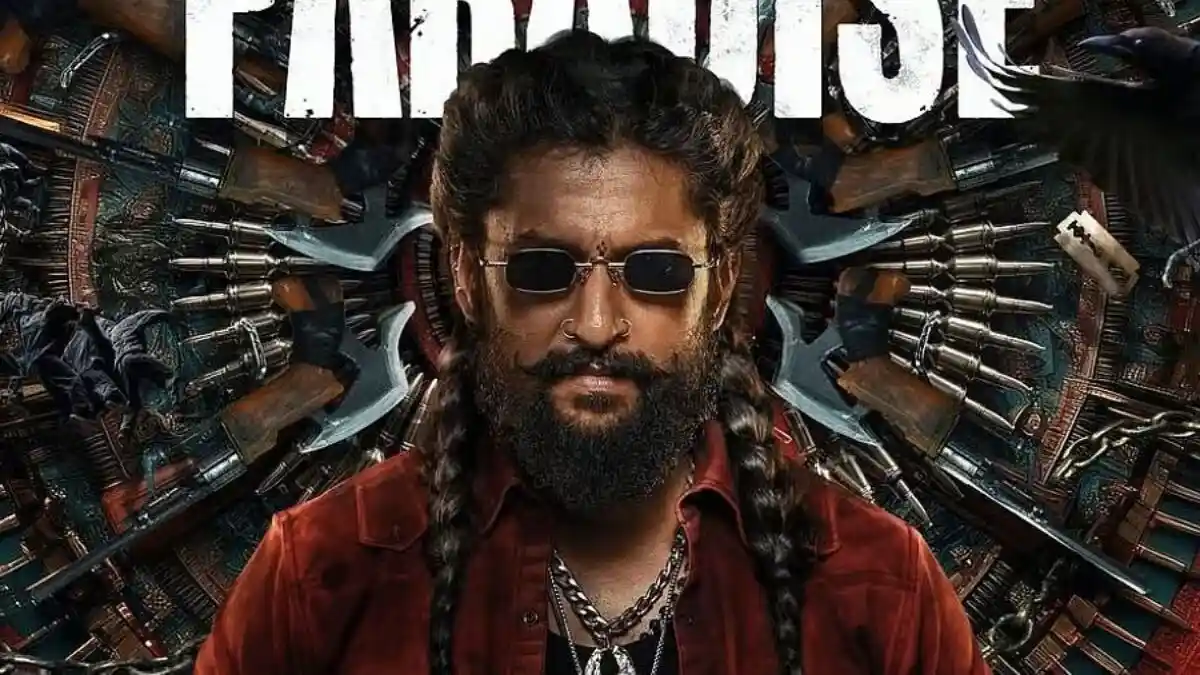
Nani and director Srikanth Odela are back together after Dasara, and The Paradise is a pretty big departure from the kind of roles we usually associate with the actor. Set in 1980s Secunderabad, the film throws Nani into a much rougher world, where crime, violence and survival are part of everyday life. There was quite a bit of hype around the reunion, and the film certainly doesn’t hold back when it comes to scale or aggression. Nani is joined by Kayadu Lohar, Mohan Babu, Sampoornesh Babu, Sonali Kulkarni and Raghav Juyal, with Anirudh Ravichander handling the music and Sudhakar Cherukuri producing the film under SLV Cinemas.
The interesting thing about The Paradise is that it clearly wants to be more than just another star-driven action movie. It spends a lot of time building its world, establishing the people who live in it and showing why violence has become such an important part of their lives. At its best, the film feels grimy, loud and unpredictable. Unfortunately, it doesn’t quite manage to hold onto that feeling once the second half begins.
A Story Built Around Anger, Power and Survival
The film takes place in the Paradise area of Secunderabad during the 1980s and focuses on the Savaris, a tribal community fighting for official recognition and basic rights. Sammakka (Sonali Kulkarni) has spent years trying to get her people heard, while also standing up to Shikanja Malik (Mohan Babu), a powerful local figure who has no intention of giving up his control over the area.
Her son Jadal (Nani) grows up watching all of this, but he doesn’t share his mother’s belief that peaceful resistance is going to change anything. In fact, he carries a lot of resentment toward her from his childhood, and that anger eventually sends him in a completely different direction. Jadal turns toward crime and violence because, in his mind, that’s the only language the people in power actually understand.
It’s a simple idea, but it gives Nani’s character a lot to work with. Jadal isn’t trying to become a hero in the traditional sense. He wants respect, and he wants people to stop treating him and his community as if they don’t matter. The problem is that the path he chooses only pulls him deeper into the same violent system he’s trying to challenge.
Nani Goes Full Aggressive Mode
Nani is probably the biggest reason to watch The Paradise. This isn’t the warm, approachable version of the actor that audiences have become used to seeing. Jadal is angry, unpredictable and physically intimidating, and Nani commits to the character instead of trying to make him more likable than he needs to be.
A lot of the film’s best moments come when Jadal is allowed to simply take over the screen. The action scenes have weight to them, and Nani’s body language does a surprising amount of the work. Even before he says anything, you can usually tell what kind of mood Jadal is in. The actor also handles the more emotional side of the character well, particularly when the story brings his complicated relationship with his mother back into focus.
The supporting cast helps, too. Mohan Babu brings plenty of presence to Shikanja Malik, while Sampoornesh Babu gets a more serious dramatic role than audiences may expect from him. Sonali Kulkarni is particularly important because Sammakka gives the story its emotional grounding. Her struggle isn’t just there to set up Jadal’s transformation; it gives the film a reason to care about what happens to this community in the first place.
The First Half Is Where the Film Really Works
Visually, The Paradise does a good job creating its period setting. The production design, sets and cinematography give the world a distinctive look without making it feel overly polished. There is a roughness to the environment that fits the story, and the film benefits from taking its time to establish that atmosphere.
The stretch leading up to the interval is easily one of the strongest parts of the movie. The tension keeps building, the action gets increasingly intense, and the staging of some of the major sequences gives the film the kind of scale you’d expect from a big-screen action drama. This is where Srikanth Odela’s direction really clicks. The film knows when to slow down and let a moment sit, and when to turn up the violence.
Anirudh Ravichander’s music also adds plenty of energy. When the visuals, action and score are working together, The Paradise can be a seriously loud and exciting experience. Sometimes it feels like the movie is almost daring the audience to keep up with it.
The Second Half Starts Losing the Momentum
The problem is that the film doesn’t maintain that same confidence after the interval. The first half builds a lot of momentum, but the writing starts to feel less focused once the story moves forward. Some of the emotional beats don’t land with the same force, and the film begins jumping between its different threads without always giving them enough room to develop.
The censor cuts don’t help either. Some of the explicit language and graphic violence have reportedly been trimmed, and you can feel the damage in certain scenes. Dialogues sometimes feel like they have been chopped off before they properly finish, while a few sequences don’t flow as smoothly as they should. It isn’t just about losing a few strong words or violent shots; the cuts can make certain scenes feel oddly disconnected.
There are also some sound-mixing issues. Anirudh’s background score is often energetic and effective, but there are moments when it simply becomes too loud, particularly during dramatic exchanges. When the music starts competing with the dialogue, you’re left trying to figure out what a character just said instead of actually following the scene. That’s a technical issue, but it matters more than it might sound because so much of the film depends on its dramatic confrontations.
Final Verdict
The Paradise is clearly an ambitious film, and there is quite a lot to admire in what it is trying to do. The period setting looks convincing, the action has plenty of punch, and Nani throws himself into a role that feels very different from his usual screen image. The first half, in particular, has the kind of energy and visual confidence that makes you want to see where the movie is going.
But the second half doesn’t quite live up to that start. The writing loses some of its emotional weight, the pacing becomes less consistent, and the censor cuts and sound-balancing problems make parts of the film feel rougher than they should. Still, if you’re going mainly for Nani in an unusually raw and aggressive role, there is plenty here to enjoy. The Paradise may not hold together perfectly, but when it gets going, it certainly knows how to make some noise.